Ah Yu | The Designer of the handcraft life
Pushing boundaries, embracing imperfection


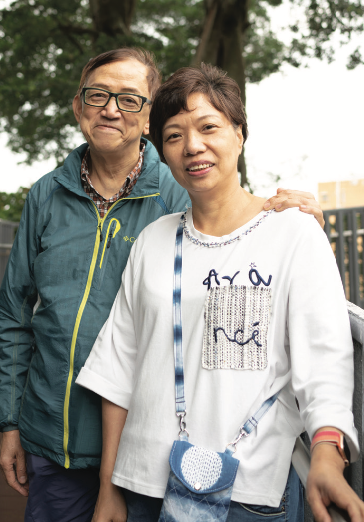


Ah Yu's father started a plastic toy factory from scratch in Hong Kong. Since she was a child, she has worked in the factory as a helper and learned a lot about how the handcraft industry works. Due to the global economic downturn, the factory was eventually closed due to the decline of the industry. As Ah Yu began to enjoy her free time, she noticed that her husband, who worked as a chef, was a good cook and was often praised for his cooking skills, so she began to explore her own interests and specialisms. When she saw the beautiful bags her sister made at home, she became interested in sewing and tried to learn how to make bags. After her first experience with a sewing machine, she learnt to make a variety of small accessories, making eco-bags for her own use or as gifts for her friends. Everyone appreciated her craftsmanship and her family loved to give the eco-bags she made to their friends. Her husband says it's a meaningful gift because it's handmade and there is no similar product on the market.
Recognizing each other
Ah Yu's first participation in a village activity was in 2017, which involved dyeing sappan wood. At that time, the introverted Ah Yu wasn't too keen on participating in village activities; although she found them interesting, she didn't continue to learn. In 2018, her husband heard from Ann that a group of village aunties were learning natural dyeing, so he encouraged Ah Yu to join, which led to her joining the village aunties' studio. As Ah Yu devoted herself to dyeing and sewing, her husband began to pay attention to his wife's handcrafts and asked Ah Yu to dye a T-shirt for him. When he wore it and received compliments from his friends, Ah Yu saw a sense of pride in his eyes. Then he started talking about "his wife's handcrafts" and took the initiative to participate in village activities with Ah Yu. Everyone could feel his admiration and heartfelt appreciation for his wife. Now, when Ah Yu practises natural dyeing with the others, her husband takes the initiative to prepare snacks and desserts and bring them to the group during breaks. In 2021, they moved from Pokfulam to Kowloon, and after renovating their home, her husband even gave up his wardrobe for Ah Yu to store her sewing machine, fabric and accessories, etc. "From the beginning, I wanted to be as capable as my husband, but now we appreciate each other, which is a change I never expected. Perhaps it was through studying handicrafts that I began to understand my husband's passion for research and cooking with his own hands. It turns out that people who like to work with their hands have a desire to pursue themselves and that their happiness comes from the satisfaction they get from working with their hands. Once I understood this mentality, our hearts and minds became one," she says.
About pottery
After experimenting with ceramics, Ah Yu discovered that it required as much concentration as sewing, otherwise it was easy to fail. She once suffered from trigeminal neuralgia, which affected her life for almost half a year, except when she was sewing she could forget the pain. Brian explained this phenomenon with the term "mindflow", which means that when a person reaches a state of extreme concentration, he or she forgets many psychological and even physiological reactions, or perhaps Ah Yu has reached a state of "mindflow".
Like most of the students, Ah Yu is new to pottery and often makes mistakes at the beginning, but gradually adapts and accepts that she will make mistakes. "I have learnt a lot from my mistakes, sometimes I would not remember the steps if everything went well, so the experience of making mistakes helped me to calm down, learn from my mistakes and have a deeper understanding of the craft! Ah Yu finds it most difficult to master the "feel" of the craft, especially in the area of accommodation. For her, the so-called sense of touch is about strength and rhythm. She believes that it takes time and training to realise this, and Brian says that this is a barrier to learning pottery, and that if you can break through this barrier, you will be able to make pottery with ease.
Teaching and learning
Ah Yu feels that she used to be rigid and inflexible, only following other people's demonstrations or teaching instructions, especially in sewing, without following the demonstrations she would easily make mistakes. However, through the Indigo Dyeing programme, she began to create tie-dye patterns in her own way, and always ended up with unexpected results. "By using different folding methods, I was surprised every time I opened the dyed fabric. Apart from this surprise, I've learnt from the teaching experience of the indigo dyeing workshops that each composition has its own uniqueness, resulting in different patterns. Although beginners are more casual and simple, it turns out that they can make some unprecedented variations instead of following the rules, and this made me think a lot about what is meant by "teaching for the sake of learning". I then had the courage to add my own creativity to the sewing process, and after more practice, I could really do it with my own ideas, and finally remove the limitations I had placed on myself".
Whenever she was in front of a crowd, Ah Yu would get nervous and her mind would not work, but with the support of other members who took turns hosting the workshops, she realised that she had the responsibility to take on the role of host, so she gave it a try. The most memorable time was when she hosted a workshop on indigo dyeing. The participants were all foreigners, and as Ah Yu's English was not very good, she could only use her body language to express herself. At first she was afraid that language was the only way to communicate with others, but she realised that it wasn't the only way. The participants patiently watched Ah Yu's demonstration and soon got the hang of it, and the surprise of untying the dyed fabric at the end made everyone forget their language problems. It turned out that if she was willing to try, she could break through the barriers in her mind.
As she learned more about the art of dyeing, she realised that it wasn't easy to dye a piece of cloth, but now she could do it all, from dyeing to sewing! After a few years of training, she learnt more and realised what a good piece of work was, and she began to set certain standards for herself. When she saw Mei Yi's ability to master the techniques and make beautiful patterns right from the start, she was surprised and envious, hoping that she could improve, and her motivation was also aroused! So she often asked everyone for advice, and they were willing to teach her, so she made progress. Another thing she learnt from her time with the village aunties was the art of giving compliments. "I used to be more introverted and rarely took the initiative to praise others, even if I appreciated them, I was too shy to say so. But as we got to know each other better, we took the initiative to praise each other's work, which inspired us to encourage each other, and now sincere compliments come so naturally," she says.
I remember once when I was showing a Japanese indigo design to the village aunties, Jenny and Ah Yu said in the same breath, "Wow, this is so cute and pretty! "The objects in front of me were so interesting to the village aunties, and their innocence and openness made me feel that most of them were now mothers and suddenly "so girly".
Meeting like-minded friends
The eco-bags that Ah Yu makes are different from those sold in the market; after giving them to her friends and relatives, they all praise them and ask her to make more for them, as they are both practical and beautiful. So far, she has probably made close to a hundred of these bags, with carefully selected fabrics and a practical design that makes it easy to store more items. "When I look at the finished bag, I feel so satisfied that sometimes I don't even want to give it to anyone! In the past, when I was learning from YouTube at home, no one gave me advice or cared about me, so I felt very lonely doing my own crafts. Now we have a lot of experience in crafting together, especially when we meet like-minded people, we appreciate and learn from each other, and to be appreciated by people who know what they are doing is a resonance of praise, so it is certainly a different feeling.
Natural indigo dyeing is a very special dye that produces different patterns by varying the dipping time and oxidation, so every indigo dyeing is full of surprises. The village aunties treasure their hand-dyed pieces, because only those who have tried them understand that it is not easy to dye a piece of cloth to a satisfactory finish. Although they originally dyed the fabric for needlework, they are often reluctant to cut it up when they see the unique patterns they have dyed. Even if someone were to tie the fabric in the same way again, the pattern would not be the same. Natural dyeing and handcrafts are so wonderful that the village aunties often emphasise that "you can't get the same pattern again even if you want to", a feeling that only those who are passionate about natural dyeing can share.
"I hope you can feel the satisfaction and joy of being part of a group of people making handmade items. This change has also inspired me to see my own potential and what I can do to improve my character. I hope that life will influence life and inspire more people to take the first step to discover themselves and live a better life."