Sally | Masterful Homemaker
Learning from different people to build her own "mastery"

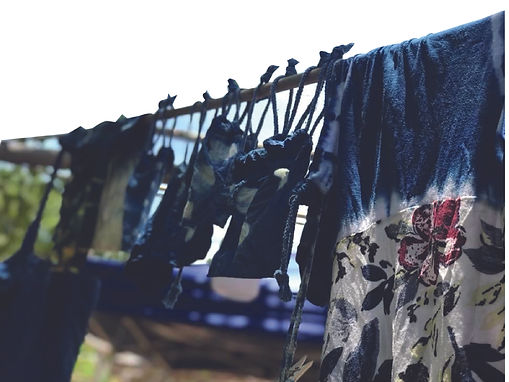


Like many village aunties, Sally moved to the village with her husband after marriage and has been a daughter-in-law of the Ng's family for more than 30 years. When I first met Sally, she was very quiet and shy. In 2018, she helped the Conservancy Association organise the village's first natural indigo dyeing and butterfly pea flower dyeing with rice balls, and was so busy at the time that she even forgot to eat lunch. At the end of the event, when everyone had gone home with dyed rice balls and indigo scarves, Sally handed me two large rice balls and said just two words, "For you". After a long day of work, I finally remembered that I was hungry and was a little touched. Even though two rice balls seemed like a lot, I didn't waste them and ate them all. The warmth and satisfaction I felt from the rice balls is still with me today.
Bringing warmth into our lives with our hands
Before the establishment of the Village Aunties' Studio, Sally used to do handicrafts, but they were limited to patching and sewing. When the Village Aunties first learned to sew and dye together, she used old socks to make little pin cushions for everyone. Now that she has learnt to dye and make pottery, she makes scarves and pottery for her friends. "Unlike buying ready-made gifts, handmade items have a warmth that is appreciated by the recipient. Even though I'm not a professional, it's a small token of my gratitude to make them happy," she says.
Sometimes, if you pass by the village aunties' workshop, formerly the "Happy Restaurant", you will see Sally stirring a vat of indigo dye or conducting activities to promote the village. Even when Sally isn't on duty, she's still very much involved in the workshop, helping out from time to time. Sally considers herself a fairly calm person who doesn't have too many ups and downs in her emotions, but when the village aunties start a craft activity, she gets very excited and looks forward to learning with them. "To be honest, every time I practise or conduct an activity, I have to do a lot of preparation before and clean up after, but the encouragement and recognition I get from the Village Aunties' Studio cannot be measured in monetary terms. During my time at the Village Aunties' Studio, I saw myself and began to build my confidence. I am still grateful to everyone for walking with me and respecting each other equally. With the support of this group of friends, I slowly learned to express my innermost feelings and thoughts.
The mastery of a village auntie
With volunteer mentors coming in and training the village aunties in their crafts, they have all worked hard to learn and develop their crafts into something more diversified. They have demonstrated their skills at village events and even shared their crafts with people outside Pokfulam Village, such as at JCCAC, Nan Fung Yarn Factory and the West Kowloon Cultural District. From time to time, friends from outside the village have praised the village auntie's skills. What exactly is "the skill of a village auntie"?
"Growing up in a single-parent family, my mother's influences had a profound effect on my thinking. Traditionally, a woman's ability to run a family, to be a good wife to her husband and a loving mother to her children is considered a 'skill', but living in the Village Aunties' Studio has given me a different kind of inspiration. The various activities and meetings not only broaden our skills, but also our horizons and knowledge. In addition, as a member of the Pokfulam Village Conservation Group and Lok Gun Yuen, I am often involved in preserving the culture and traditions of the village. As the Chinese saying goes, "where there are three of us, there must be someone to learn from". I have learnt the skills of other village aunties, which has inspired me to be a competent person. Sally always worried that she would have nothing to do when she retired. But after learning a craft, Sally realised that she would be the one to benefit in the end. She may not be able to achieve anything great, but at least she feels she will have more choices in the future," she says. "Now I'm thinking that if I continue to learn the craft, I could start a small business with my crafts and that would be nice! I think using my hands to live the life I want is what I mean by 'mastery'!
Learning from crafts to seize opportunities
For most people in Hong Kong, it is easy to buy a piece of dyed fabric or a rice bowl. From a practical and economic point of view, handmade goods are expensive and unproductive, and the gradual decline of traditional crafts seems inevitable. For Sally, however, continuing to learn traditional crafts is an important part of her cultural heritage. "There is a difference between buying something and making it. Through the process of making something yourself, you can learn about the intentions and efforts of your predecessors and understand the value of craftsmanship. Like chemical dyeing, I knew it was cheap and time-saving, but after learning natural dyeing, I realised the meaning behind it and changed my attitude". Recently, Sally had an idea to make a pair of curtains by beating all the beautiful wild flowers and leaves of Pokfulam village on a piece of cloth, and the idea of the whole process of making them made her very excited. "Honestly, I understand that the natural colours will fade in a few months, and one day they might even disappear completely, so I'm mentally prepared for that, we can't force it, so let's just take things as they come.
The aesthetics of order in chaos
Sally is a passionate person who does not sweat the small stuff and who lacks patience. She has certain expectations of herself and does not like to be stereotyped. Even though she is trained with a frame and mould, once she has learnt the basic techniques, she would add her own creativity to make her work more personal. For example, if she sees wildflowers and weeds in her neighbourhood and thinks they are unique, she picks them and arranges them in a flower pot outside her door. Although there are different kinds of plants in the pot, she arranges them according to her own feeling so that it is not too messy. Later, a villager walked by and praised the arrangement, noting that it was tidy in the midst of chaos. "Or maybe that's just my style. Whenever I have an idea, I just 'try it out'. I don't calculate too much, so my work is rarely neat and tidy, and I don't like to stick to the rules," she says. The natural harmony of the messy beauty gives the track a bit of poetry.
The most impressive work
At the 2022 Village Festival, the village aunties dyed more than a dozen indigo-dyed handkerchiefs for guests, who were surprised and deeply touched by the work. Sally remembers with a heartfelt smile, "Even though I was not there, it was a source of satisfaction for me, and that came from the joy of being appreciated. Everyone's efforts also motivated me to do a good job and not disappoint the visitors, so I feel even more responsible to learn this craft and let more people know about it and even get interested in it, so that it can be passed on from one generation to the next". In September 2022, a group of young people came to participate in the traditional rice paste dyeing workshop. It was the first time they had been exposed to indigo dyeing, and they must have been newcomers to the art compared to the village aunties who had been doing natural dyeing for many years. However, in the process of creating their artwork, they were like children, full of imagination about their surroundings, and had no preconceived ideas about how to limit their creativity. They casually picked up insect-eaten amaranth leaves and turned them into beautiful patterns, and they also created their own way of making the stencil paper into a round shape to frame the dye patterns. This made Sally realise that as long as she thinks 'outside the box' she will have a different understanding, and this is the creativity she has learnt from other people through interaction. She ended up using decaying leaves and weeds to create a poetic pattern, and this handmade piece is her most satisfying yet.
Recognition of identity as a villager
In 2021, they received a batch of local Chinese yam and tried dyeing with it. The yam is rich in tannins and colloids, and the old generation of Hong Kong fishermen used it to dye woven hemp fishnets. After repeated dyeing and tanning, the texture of the fishnets became strong and durable, with low water permeability, abrasion resistance and waterproofness. Ancient people used yam-dyed silk to make "Gambiered Canton Gauze". They covered the dyed silk with a layer of river mud, which is rich in minerals. After drying and washing, the cloth becomes strong, wearable and easy to dry, and this process has been listed as a national intangible cultural heritage of China.
The bright, deep orange colour of the yam-dyed silk scarves hanging outside the old house created a striking contrast and attracted the attention of the neighbourhood. A villager, whom I do not know, walked by with her friend from outside the village, who commented on the beauty of the dyed scarves, and then the villager said, "We dyed them ourselves! The "we" represents the villagers' recognition of their own identity and the value that the aunt has brought to Pokfulam - not just joy and pride, but also a sense of belonging. Perhaps it is also the extraordinary talent of a group of women who are passionate about handcrafts.
"I want to show people through this book that there is room for improvement for everyone and that I can do it all."